The Mind in the Machine: Navigating the Psychology of AI
Why do 80% of AI deployments fail to deliver value? It isn’t a lack of processing power—it’s a…
Corporate leadership has fallen into the trap of “checkbox innovation.” In a desperate bid to satisfy AI initiatives, organizations are “throwing a chatbot” at complex problems with zero strategic intent.…
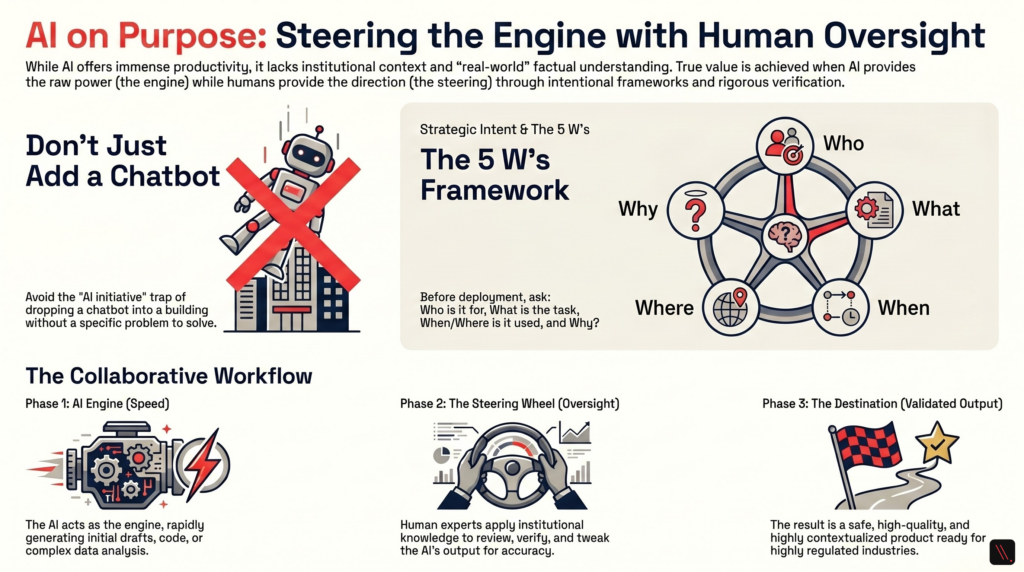
Corporate leadership has fallen into the trap of “checkbox innovation.” In a desperate bid to satisfy AI initiatives, organizations are “throwing a chatbot” at complex problems with zero strategic intent. This isn’t innovation; it is a “monkey’s paw” scenario where the facade of productivity masks a dangerous lack of professional expertise.
Deploying a Large Language Model (LLM) as a substitute for years of specialized training is not just a strategic error—it is a liability. When organizations use conversational interfaces for high-stakes tasks without a human filter, they trade institutional integrity for a “vibe” of efficiency.
“When you say people are using AI as a therapist, that’s such a red flag to me… there are people who have studied mental health and who have gone through years and years of training… to just go to something that’s just pulling random stuff from online and asking what’s wrong with me… that’s not a professional diagnosis.” — Ashley Rissmeyer – Season 1 | Episode 2
The antidote to “checkbox” AI is doing it on purpose. Before a single line of code is written or a seat is purchased, organizations must conduct a rigorous pre-deployment audit. This framework prevents the “AI-first” trap, ensuring technology serves the business problem rather than searching for one.
The “Five W’s” of Intentional AI Adoption:
The public perception of LLMs as “intelligent entities” obfuscates the underlying technology. LLMs are Natural Language Processing (NLP) models; they are pattern-prediction engines that do not even “know they have a name.”
As illustrated by the “moon landing” anecdote, a human might forget if Buzz Aldrin or Neil Armstrong walked first, but they understand that a factual world-state exists. An LLM possesses no such world-state or sense of history. It operates on weighted data patterns, meaning it can provide a confident answer that is factually untethered from reality.
| Human Communication | LLM Communication (NLP) |
|---|---|
| Operates within a shared world-state and factual history. | Operates on weighted data patterns from training sets. |
| Understands that a “truth” exists, even if it is forgotten. | Lacks context; “truth” is merely high-probability token prediction. |
| Rooted in professional training and institutional intuition. | Susceptible to “hallucinations” and “rogue” data from the open web. |
| Provides expert diagnosis based on years of context. | Provides probabilistic outputs that require manual verification. |
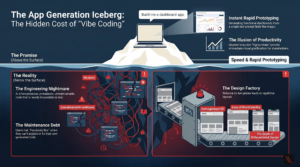
“Vibe coding”—the practice of building applications through natural language descriptions—is a Pandora’s Box of technical debt. While it allows for rapid prototyping, it creates logic that is nearly impossible to capture, debug, or maintain manually.
Consider the “Figma Make” incident: a developer attempted to change images in an AI-generated React file, only to find the entire structure broken because the LLM-generated code didn’t handle image uploads like a human-built system. If your team cannot explain the code, they cannot test it, and they certainly cannot evolve it.
The Risks of Vibe-Coded Logic:
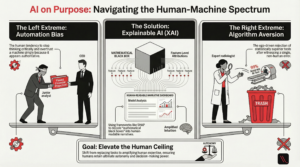
We have evolved from walking to horse-and-buggy to regular cars. While we are racing toward autonomy, the technology is currently in a volatile transition period that requires a “driver” at all times.
“Tesla tried to do some autopilot stuff. We’ve all seen the news reports of how that turned out. So, I think we’re kind of in that era now of we still need someone to be engaged with the AI to make sure it’s behaving as expected. It’s not crashing and burning. It’s not hallucinating.” — Ashley Rissmeyer – Season 1 | Episode 2
In regulated industries, blind trust in AI is a fast track to being fined or sued. The “Human in the Loop” (HITL) isn’t a bottleneck; it is the final safeguard. This philosophy prioritizes human intuition—the metaphorical “finger marks” on the work—to validate what the machine predicts.
Strategically, it is often more efficient to have a human conduct a five-minute review than to spend weeks engineering “obscene,” two-page prompts to handle every edge case. Transparency tools like “Doc Center” or “pins” are essential UI requirements, allowing humans to verify sources and perform the due diligence that machines cannot.
The Strategic Human Value-Add:
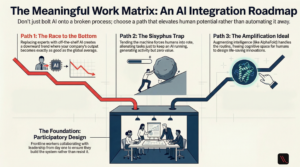
The shift from “AI-first” to “Intent-first” is the only way to avoid the cannibalization of talent and the accumulation of unmanageable technical debt. AI should expedite the building process, but it cannot be trusted to drive the business alone. In an era of homogeneous, AI-generated noise, the “Human in the Loop” is the only filter that matters for institutional survival.
Why do 80% of AI deployments fail to deliver value? It isn’t a lack of processing power—it’s a…
In the current landscape of rapid software development, a seductive new trend has emerged: “vibe coding.” This practice—building…
The modern enterprise is currently gripped by a specific kind of organizational panic. Following the rapid ascent of…