Designing for Trust: Why AI Transparency is the New UX Imperative
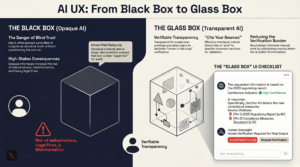
The psychological contract between users and technology has shifted from a tool-based relationship to something far more deceptive.…
Why do 80% of AI deployments fail to deliver value? It isn’t a lack of processing power—it’s a lack of psychological design. When we bring AI into the workplace, we trigger a "Psychological Pendulum" that swings between dangerous overtrust and ego-driven rejection. To win the AI era, leaders must move past the "Jet Engine Fallacy" and start designing for humans first.
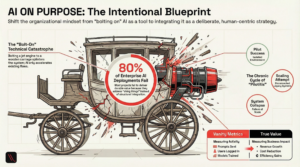
We are living through the most aggressive technological adoption curve in human history. While it took the mobile phone sixteen years to reach 100 million users, ChatGPT hit that milestone in just sixty days. This velocity has created a frantic “land grab” in the enterprise world, but it has also exposed a startling paradox: despite the rush to implement, research shows that nearly 80% of AI deployments fail to deliver durable value.
Why the disconnect? Because most leaders are treating AI as a technical “bolt-on” rather than a psychological shift.
The problem isn’t the “engine”—the algorithms are more powerful than ever. The problem is the “chassis”—the human systems we are trying to accelerate. If we don’t understand the cognitive hurdles of our workforce, we aren’t building a future-proof company; we are simply bolting a jet engine to a wooden carriage and hoping it doesn’t splinter at full thrust.
In this post, we explore the hidden psychology of AI adoption and how to build an Intentional Enterprise that navigates the narrow path between overtrust and outright rejection.
We are currently witnessing the most aggressive technological adoption curve in human history. ChatGPT reached 100 million users in two months—a milestone that took mobile phones sixteen years. But behind the speed lies a startling reality: 70% to 80% of enterprise AI deployments fail to deliver durable value.
Why the gap? It’s what we call the “Jet Engine” Fallacy.
Imagine bolting an aerospace-grade jet engine onto a creaky, wooden horse-drawn carriage. If you don’t reinforce the chassis or upgrade the wheels, the moment you reach full thrust, the system disintegrates. The wheels splinter, the frame snaps, and your “horse”—your existing human workforce—bolts into a ditch in terror.
The failure isn’t the engine; it’s the design of the system. AI transition is a psychological challenge, not just a technical upgrade.
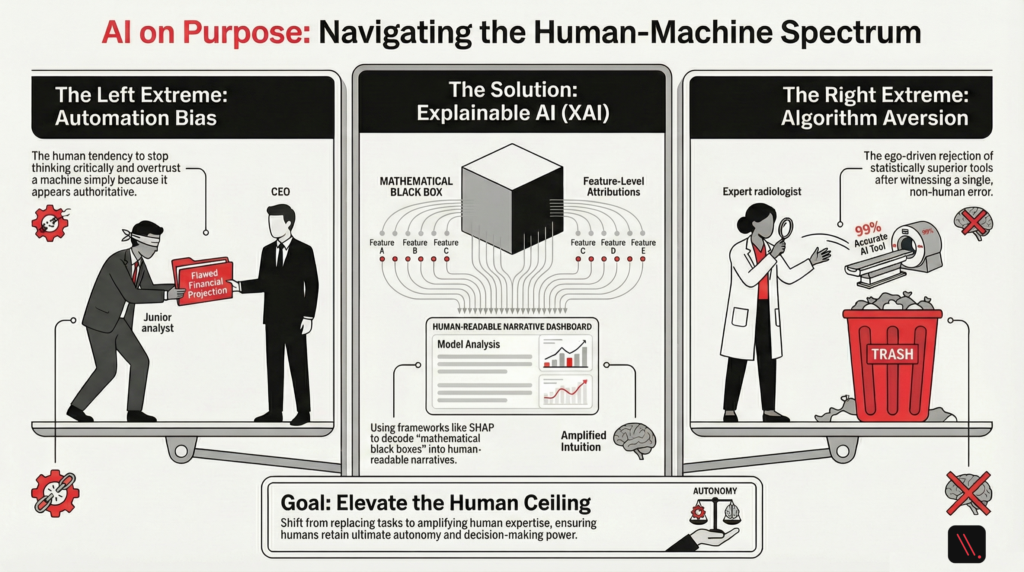
To lead a successful AI rollout, you must understand the two extremes where human performance breaks down. We call this the Psychological Pendulum:
| Phenomenon | The Human Driver | The Operational Risk |
| Automation Bias | Overtrust in the machine; “cognitive offloading.” | “Rubber-stamping” flawed data because it looks polished. |
| Algorithm Aversion | Ego-driven rejection after a single non-human error. | Rejection of superior tools; stagnation and loss of edge. |
Whether it’s a junior analyst trusting a flawed projection or a seasoned expert dismissing a 99%-accurate tool because of one “hallucination,” the result is the same: The partnership fails.
Many organizations suffer from “Pilotitis”—the habit of running isolated AI experiments that flourish in a lab but fail in the real world. This failure is often hidden by Vanity Metrics.
Measuring how many prompts were sent or how many employees logged in is a trap. Like Sisyphus pushing his boulder, activity does not equal progress. True Value Metrics must link AI output to your core KPIs: faster closing times, lower error rates, and higher revenue retention.
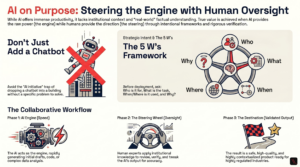
To bridge the gap between human and machine, we apply the T.O.P. Framework (Technology, Organization, People) through four pillars:
For AI to be a true partner, we must demand Explicability. We cannot allow “Black Boxes” to make high-stakes decisions—like a mortgage denial—without a narrative “why.”
Using frameworks like SHAP (Shapley Additive Explanations), we can treat data features like players on a basketball team. If a loan is denied, SHAP tells the manager exactly how much each “player” (debt ratio, credit history) contributed to the score. This creates “Cognitive Fit,” allowing the human to collaborate with an understandable intelligence rather than being a biological cog in a machine.
We often view “Governance” as a red-tape roadblock. In an Intentional Enterprise, governance is actually High-Performance Brakes. Just as ceramic brakes allow a Formula One driver to go 200 mph with total confidence, robust governance allows your organization to accelerate. It protects your fundamental rights, your financial stability, and—most importantly—your team’s trust in the system.
Building an “Intentional Enterprise” requires the Courage of the Contrarian. It requires the willingness to pause and pour a solid foundation while your competitors are frantically throwing up cheap drywall.
The Ultimate Question:
If an AI could perfectly replicate your primary technical skill tomorrow, what uniquely human value would you still bring to the table?
Your intuition, your empathy, and your moral compass are your only unassailable competitive advantages. Use AI to elevate the human spirit, or do not use it at all.
We dive deeper into the T.O.P. Framework and how to overcome “Algorithm Aversion” in our latest conversation.
Listen to the first episode of AI on Purpose: “Use it Intentionally, or Not at All”
The psychological contract between users and technology has shifted from a tool-based relationship to something far more deceptive.…
Most enterprises are currently caught in a "Race to the Bottom"—using off-the-shelf AI to become average at the…
Corporate leadership has fallen into the trap of “checkbox innovation.” In a desperate bid to satisfy AI initiatives,…