Beyond the Baseline: Ambing Your Workforce, Not Replacing It
Most enterprises are currently caught in a "Race to the Bottom"—using off-the-shelf AI to become average at the…
In the current landscape of rapid software development, a seductive new trend has emerged: “vibe coding.” This practice—building applications through descriptive sentences and AI prompts rather than manual, intentional architecture—is…
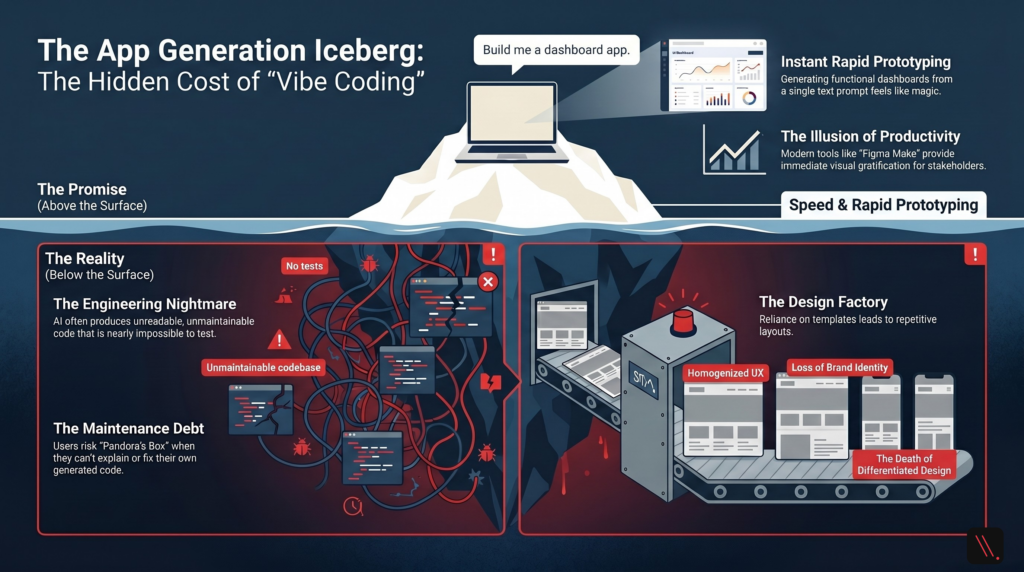
In the current landscape of rapid software development, a seductive new trend has emerged: “vibe coding.” This practice—building applications through descriptive sentences and AI prompts rather than manual, intentional architecture—is being marketed as the democratization of creation. To the uninitiated, it represents a dream where a raw idea transforms into a functional prototype in minutes.
However, as a veteran of multiple tech hype cycles, I see this not as a revolution, but as a looming era of architectural malpractice. While the speed of generation is intoxicating, it masks a structural instability that threatens the very foundation of professional software. We are trading long-term software health for immediate gratification. This critique explores the two-fold crisis inherent in this approach: a technical nightmare of unmaintainable “black box” code and a creative crisis that is drowning the industry in a sea of design homogenization.
A central tenet of mature software engineering is the ability to write code that is “easy to delete.” In a healthy, human-architected project, modules are decoupled and understood well enough that they can be replaced or excised without the entire system collapsing. Vibe coding produces the exact opposite: a brittle, opaque sprawl where the “why” behind every line is missing.
When using tools like Figma’s “Make” feature or LLMs to generate React components, the output often relies on non-standard, “weird specific LLM things.” For instance, an AI might implement an asset pipeline or image upload behavior that diverges fundamentally from standard practices. Because a human didn’t architect the logic, they cannot effectively debug it when it breaks. If you cannot explain why a 500-line block of code exists, you cannot delete it. You are stuck with it—forever.
The primary architectural risks of a vibe-coded codebase include:
The “can of worms” opened by AI-generated functions is most visible during the validation phase. There is a growing frustration among “boots-on-the-ground” engineers who are being handed thousands of lines of AI-generated code and told to “just write tests for it.”
This is an impossible task. Testing is supposed to validate intent, but with vibe coding, there is no one to explain what the code is trying to accomplish or if it is even necessary. Without a human-in-the-loop to define the logic gates, writing tests becomes performance art rather than quality assurance.
| Feature | Traditional Development | Vibe Coding |
|---|---|---|
| Authorship | Human-authored with clear intent. | AI-authored based on descriptive “vibes.” |
| Structure | Modular; designed for deletion/extension. | Monolithic; opaque and brittle logic. |
| Validation | Verified against documented logic. | Difficult to validate; requires “reverse engineering.” |
| Knowledge Retention | Resides in the developer’s head/documentation. | Non-existent; intent vanishes after the prompt. |
From a UX strategy perspective, vibe coding is a suicide pact for brand identity. AI models are trained on the “average” of the internet; they default to the most probable solutions. This results in a “sea of sameness” where every interface is a derivative of the same KPI dashboards, generic lists, and standard action buttons.
This homogenization is the death of competitive edge. A brand’s identity is defined by its unique visual language—the specific layouts and color schemes that make a platform like YouTube instantly recognizable the moment the page loads. When a CEO relies on AI defaults, they are outsourcing their company’s personal brand to a template generator. If your app looks like every other app because it was “vibe-coded” from the same training data, you have no brand; you have a commodity.
High-stakes industries and high-end brands cannot afford to leave “the feel” of a product to a machine. We must return to “designing on purpose.” True differentiation comes from tactile, intentional processes—like Ysanne Baxter’s preference for drawing on paper to ensure a product “feels good” to use, rather than just “looking fine.”
Consider the evolution of transportation: we moved from walking to horse-and-buggy, and eventually to cars. We are currently in the “early autopilot” era of software. Just as a driver must keep their hands on the wheel to prevent a car from “crashing and burning” when the sensors fail, a developer must keep their hands on the code. Humans are required to apply institutional knowledge and strategic intent that a prompt can never capture. Without that oversight, you aren’t building a product; you’re just waiting for the crash.
The final verdict is clear: AI is a powerful tool for rapid prototyping and iterating on ideas, but it is a dangerous master for production-grade systems. Using “vibe coding” as a shortcut for institutional knowledge is a strategic failure that will result in massive technical debt and a bland, uninspired user experience.
For CEOs and lead architects, the mandate is to prioritize creative differentiation and maintainable foundations over the temporary high of generation speed. Use AI to explore the “what,” but never let it dictate the “how” without rigorous human due diligence. Strategic thinking must always triumph over blind trust in the vibe.
Most enterprises are currently caught in a "Race to the Bottom"—using off-the-shelf AI to become average at the…
Why do 80% of AI deployments fail to deliver value? It isn’t a lack of processing power—it’s a…
The psychological contract between users and technology has shifted from a tool-based relationship to something far more deceptive.…