The Hidden Costs of “Vibe Coding”: Maintainability and the Death of Differentiated Design
In the current landscape of rapid software development, a seductive new trend has emerged: “vibe coding.” This practice—building…
Most enterprises are currently caught in a "Race to the Bottom"—using off-the-shelf AI to become average at the speed of light. But the true power of AI isn't in replacing the "floor" of human effort; it’s in raising the "ceiling" of human genius. In this manifesto, we move beyond the automation myths and explore the four pillars of the Intentional Enterprise. It’s time to stop bolting jet engines to wooden carriages and start building with purpose. Dive into the shift from "replacing" to "amplifying," and listen to the premiere of the AI on Purpose podcast: "Use it Intentionally, or Not at All."
We are living through a period of “technological vertigo.” Every morning, a new model drops, a new competitor automates, and a new headline suggests that the human worker is an endangered species. For leaders and tech enthusiasts, the pressure isn’t just to keep up—it’s to survive.
But in the frantic rush to implement, we’ve reached a critical crossroads. One path leads to Accidental AI: a world of “bolt-on” tools, fragmented data, and a workforce that feels replaced rather than recharged. The other path—the one we explore deeply on our new podcast, AI on Purpose—is the path of the Intentional Enterprise.
This isn’t about doing more with less; it’s about doing what was previously impossible. It’s about moving beyond the “baseline” of average output and building a future where technology doesn’t just replicate human effort—it amplifies human genius.
If you’ve felt the “organizational panic” of the last year, this manifesto is your reset. Let’s look at why the current approach is failing, and how we can start building with intent.
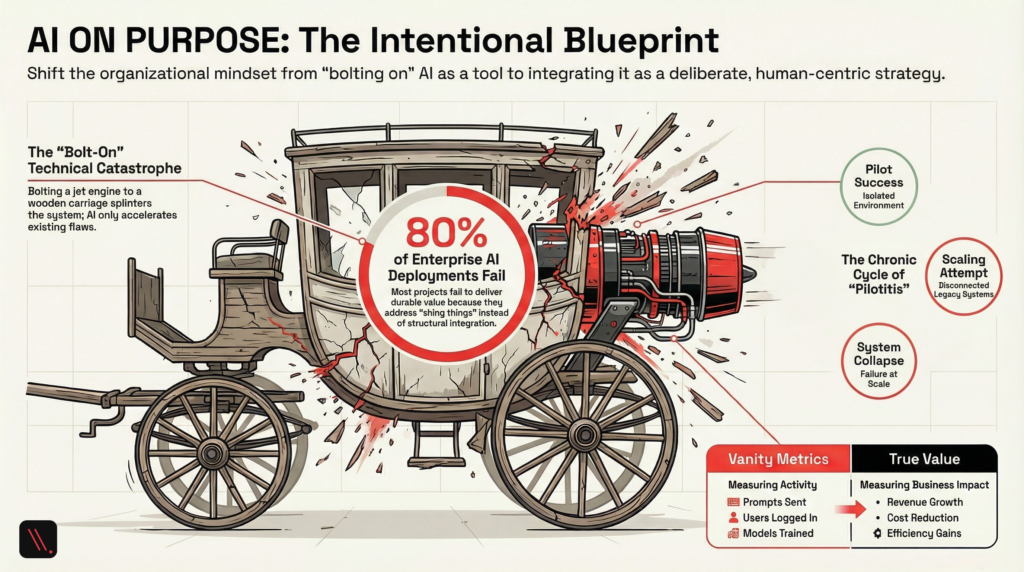
The modern enterprise is currently gripped by a specific kind of organizational fever. Boards and leadership teams are feeling the heat to implement automation strategies overnight, fueled by data—like the 2023 McKinsey study—suggesting that 62% of business tasks could be automated today.
But here is the danger: When we look at those numbers and see only “immediate margin expansion,” we fall into the Race to the Bottom. If you use the same off-the-shelf tools as your competitors to automate the same tasks, your output inevitably becomes the “global average.” You aren’t gaining an edge; you’re becoming average at the speed of light.
This is the Intentional AI manifesto. We believe the future must be designed by intent, not by accident. It’s time to move beyond the allure of a cheaper automated baseline and focus on a strategy that amplifies human intelligence rather than commoditizing it.
Applying exponential technology to broken business processes is a recipe for disaster. Imagine a logistics company using a horse-drawn carriage. To get more velocity, they bolt a state-of-the-art jet engine to the back.
The result? The wooden wheels splinter, the chassis snaps, and the horse bolts. You can’t blame the engine for a failure of structural design.
In many organizations, this “bolt-on” mentality manifests as two chronic illnesses:
Before you deploy, you must choose your direction. The Intentional Enterprise selects its path based on the integrity of the human task:
To move from accidental deployment to mastery, we lean on four foundational pillars:
For AI to be a true partner, it needs Explicability. We cannot rely on “black boxes.” Tools like SHAP (Shapley Additive Explanations) allow us to see the “marginal contribution” of every piece of data—much like evaluating a basketball player’s value to a team. This ensures the human stays in the driver’s seat, equipped with the narrative behind the math.
Building an Intentional Enterprise requires the courage to move slowly now so you can move exponentially faster later. It means pouring a meticulous concrete foundation while your competitors are frantically throwing up cheap drywall.
Your unique culture, your data, and your human intuition are the only assets that cannot be commoditized. The gap between a tool and a vision is where the work of intention begins.
If an AI could replicate your technical output tomorrow, what uniquely human value would you still bring to the table? We explore this “Ultimate Question” and the roadmap for intentional growth in the debut of our new series.
Listen to the first episode of AI on Purpose: “Use it Intentionally, or Not at All”
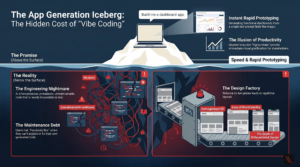
In the current landscape of rapid software development, a seductive new trend has emerged: “vibe coding.” This practice—building…
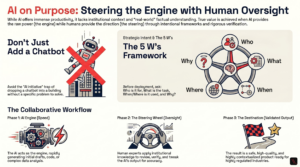
Corporate leadership has fallen into the trap of “checkbox innovation.” In a desperate bid to satisfy AI initiatives,…
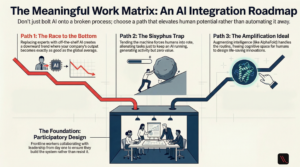
The modern enterprise is currently gripped by a specific kind of organizational panic. Following the rapid ascent of…