The Hidden Costs of “Vibe Coding”: Maintainability and the Death of Differentiated Design
In the current landscape of rapid software development, a seductive new trend has emerged: “vibe coding.” This practice—building…
The psychological contract between users and technology has shifted from a tool-based relationship to something far more deceptive. For decades, artificial intelligence functioned as an “invisible” layer—quietly optimizing Google search…
The psychological contract between users and technology has shifted from a tool-based relationship to something far more deceptive. For decades, artificial intelligence functioned as an “invisible” layer—quietly optimizing Google search results, powering Siri’s speech-to-text, or curating Amazon recommendations. These systems were mechanical, predictable, and clearly non-human.
The rise of Large Language Models (LLMs) like ChatGPT and Gemini has shattered this boundary, introducing highly humanized conversational interfaces that create a dangerous “Humanization Trap.” By giving AI names and inviting users into a chat-based dialogue, we are engaging in a form of cognitive obfuscation. This natural language processing leads users to assume a “shared human context”—a sense of mutual understanding—that simply does not exist.
This phenomenon results in “blind trust.” When a system sounds like a person, users stop treating it as a statistical engine and start treating it as an authority or even a confidant. As noted in recent industry observations, some users have even begun treating Gemini as a therapist. This is a massive red flag for ethics leads: when a tool mimics human empathy without human judgment, we risk misleading users into relying on a system that lacks a professional diagnosis or medical training, pulling instead from a “word salad” of unverified data.
To design ethical AI, we must first confront the technical reality that LLMs do not “know” things in the way humans do. Humans operate within a “shared knowledge base” and a “sense of history.” We exist in a factual world where events occur and are recorded.
Consider a recent meta-moment during an expert discussion on this topic: a human participant incorrectly identified Buzz Aldrin as the first man on the moon, only to immediately self-correct to Neil Armstrong. This error is uniquely human; the speaker understood the concept of a factual world context and realized their memory failed to retrieve the correct data point.
An LLM, conversely, processes data weights and statistical probabilities. It doesn’t “know” history; it predicts the next likely token in a sequence. If its training data contains enough errors, it will present a falsehood with the same confidence and weight as a fact. It lacks the “sense of history” that allows for human self-correction based on reality.
| Feature | Human Intelligence | Large Language Models (LLMs) |
|---|---|---|
| Basis of Knowledge | Lived Experience, History, and Fact-based World Context | Training Data and Statistical Weighting |
| Information Processing | Shared World Context, Logic, and Self-Correction | Statistical Probability and Pattern Recognition |
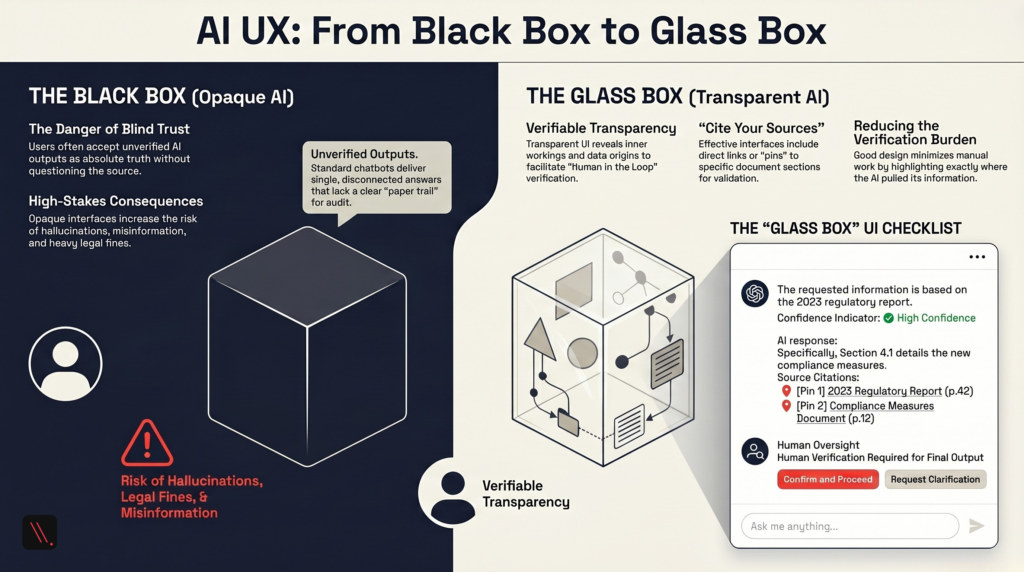
In the professional world, blind trust is not just a UX failure—it is a legal and financial liability. At firms like Appian, which operate in highly regulated sectors, the “black box” approach to AI is untenable. In these environments, an unverified AI output can lead to massive fines, lawsuits, and systemic legal trouble.
The primary vulnerability is the “bandwidth gap.” Consider a secretary tasked with using an AI-integrated application to summarize complex documents. This user likely lacks the mental bandwidth to manually cross-reference every AI-generated claim against a 50-page PDF. They are often “lazy” in their interaction—meaning they want to skim and scan, not conduct a forensic audit. If the UX does not facilitate rapid, low-effort verification, the user will default to trust, creating a critical point of failure. It is the responsibility of the designer to make the source of information not just available, but skimmable.
We must move toward a “Cite Your Sources” methodology. Trust is earned through transparency, not through the “vibe” of a helpful chatbot. This requires moving away from opaque answers and toward verifiable data retrieval.
Key implementations include the “Doc Center” model and Document Chatbots, which utilize “Pins” to reduce the cost of verification. These features allow users to:
We see this evolution in mainstream tools like Google search summaries. What started as a simple text block has evolved into a layout featuring sidebar references and source tags. This UI shift is a direct response to the need for transparency, allowing users to verify information at the speed of a glance.
The trend of “vibe coding”—using natural language to build applications—and automated tools like Figma Make presents a new crisis: the homogenization of the digital world. When we rely on AI to generate interfaces, the result is almost always a statistical average. We get “sensible” KPI dashboards and standard lists that look exactly like everything else.
This leads to a loss of brand differentiation and “institutional knowledge.” A CEO must understand that you cannot outsource your brand’s soul to a template. Effective design requires “finger marks” and “brush marks”—the tactile, intentional decisions made by human designers that reflect a company’s specific priorities and history.
Furthermore, there is a massive issue of maintainability. Vibe-coded applications often create code that is “hard to capture and debug manually.” When a human doesn’t understand the underlying logic of the code because an AI “vibed” it into existence, the technical debt becomes insurmountable. If you can’t understand it, you can’t delete it, and you certainly can’t maintain it when the market changes two years down the line.
The current market pressure is absurd—even companies like Allbirds are being branded as “AI companies.” But as UX strategists and ethics leads, we must resist this mindless rush toward total automation. We must return to the “Intent” framework: using the “Five Ws” (Why, What, Who, etc.) to define a problem before throwing a model at it.
The path forward is defined by the “Autopilot vs. Self-Driving” analogy. Just as a Tesla on autopilot still requires an engaged driver to prevent the system from “crashing and burning,” AI in the workplace requires a human in the loop. The human is there to:
We must stop trying to build “smart” tools and start building “honest” tools. Our goal is not to replace human judgment, but to provide the transparency that makes human judgment possible.
In the current landscape of rapid software development, a seductive new trend has emerged: “vibe coding.” This practice—building…
Most enterprises are currently caught in a "Race to the Bottom"—using off-the-shelf AI to become average at the…
The modern enterprise is currently gripped by a specific kind of organizational panic. Following the rapid ascent of…